
How Alignment Turns Complexity Into Action
Most organizations don't struggle because they lack talented people or good ideas. The challenge is that even when everyone is working hard, they may not be working toward the same priorities. If you've ever walked out of a leadership meeting feeling like everything is important, everyone is busy, and yet progress still feels slower than it should, you're not alone.
Recently, the Springbach team spent three days with a client facing a challenge we see more often than you might think.
They weren't lacking talented people. They weren't lacking innovative ideas. If anything, they had too many opportunities competing for attention. The problem was that no one had a clear picture of what was happening across the portfolio. Teams worked in silos, priorities weren't consistently understood, and projects often took longer than expected because there wasn't a shared way to decide what mattered most.
When we first started planning the workshop, the organization presented us with a long list of challenges. Every conversation surfaced another layer of complexity, and it would have been easy to try to solve everything at once. Instead, we made a conscious decision to simplify. Rather than tackling every issue, we focused on one goal: helping the organization better understand how it makes portfolio decisions.
Getting Everyone in the Same Room
Over three days, 20 leaders came together in person with one shared objective. Interestingly, when we interviewed participants beforehand, nearly everyone expressed some version of the same request:
"Can someone please help us understand our priorities?"
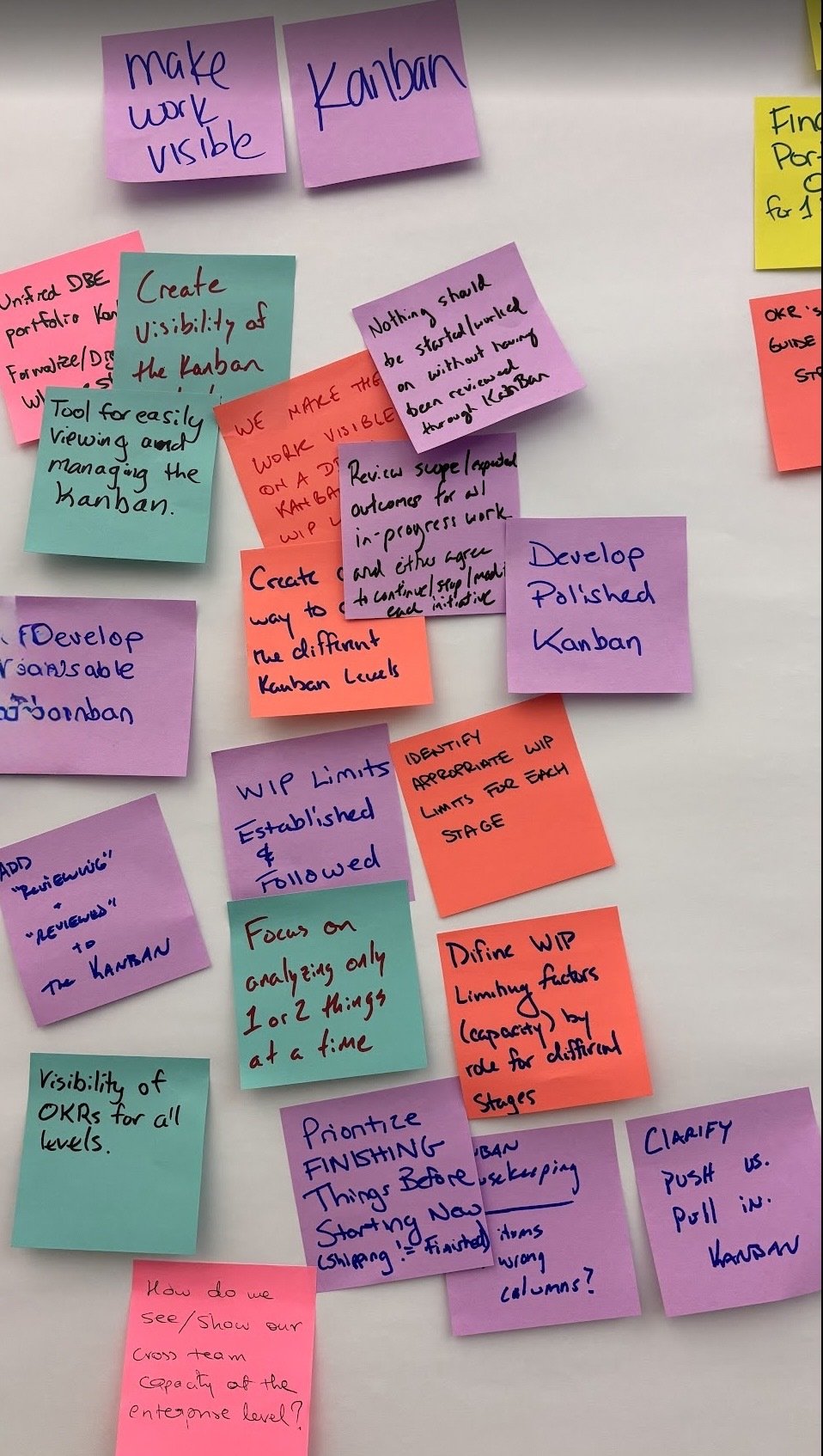
As you can see from this photo, everyone wanted help with the same thing: understanding priorities.
That question probably sounds familiar. Many organizations reach a point where everyone is working hard, but without a shared understanding of what matters most, even great teams can find themselves pulling in different directions.
There's something powerful about getting everyone in the same room with nowhere else to be. The conversations were energetic. At times they were messy, but different perspectives surfaced, assumptions were challenged, and there were moments of healthy debate. That's where true alignment began. By creating the space for people to wrestle with the same problems together, the group started moving from individual viewpoints toward a shared understanding of the organization's biggest challenges.
Together, they identified four themes that consistently stood in the way of delivering value:
They felt too far removed from their customers.
They struggled to measure whether they were realizing value from the work they completed.
Too much work was happening at the same time.
Work remained siloed across the organization.
None of these challenges existed in isolation. Each one influenced the others, making it difficult for teams to confidently decide what deserved attention first.
Introducing the Product Operating Model
One of the most engaging parts of the workshop centered on the Product Operating Model. Rather than presenting it as a replacement for the organization's existing Agile practices, we introduced it as another way to think about how work flows through the organization. We explored where the Product Operating Model and SAFe share common ground. Both focus on delivering value, collaboration, learning, and continuous improvement. Establishing those similarities helped participants recognize this wasn't about abandoning what already worked.
The conversation then shifted from "How do we deliver work?" to "Are we solving the right problems in the first place?" Instead of viewing the Product Operating Model as another framework to learn, participants began using it as a lens for making better decisions about where to invest their time and energy.
Looking for What Was Already Working
To bring those ideas to life, we asked participants to think about a project everyone in the room was familiar with. Together, they evaluated that project across each of the Product Operating Model dimensions and plotted the results on a radar chart. One project stood out immediately. It scored exceptionally well across every dimension, and that became the basis of the conversations moving forward.
Instead of spending the afternoon dissecting failures, the room became curious about success. Why had this project worked so well? What decisions did the team make differently? What behaviors contributed to that success? And perhaps most importantly, why weren't those same practices happening elsewhere?
Those questions sparked some of the best conversations of the workshop. Rather than focusing solely on what needed fixing, participants began identifying strengths they could intentionally replicate across the rest of the organization. It was a refreshing shift from problem solving to opportunity building.
Start with One Problem
Walking into the workshop, the organization had no shortage of challenges to address. Walking out, they still didn't have every answer, but they had something far more valuable: a shared understanding of where to begin.
When leaders agree on what matters most, priorities become clearer, conversations become more productive, and organizations can begin tackling complexity with confidence instead of reacting to whatever feels most urgent. Large-scale transformation rarely starts by solving every problem at once. It starts by bringing the right people together, simplifying the conversation, and building alignment around a common goal.
Sometimes, the biggest breakthrough isn't finding all the answers. It's getting everyone to agree on the right question.