
What Are the Consequences? The Question Product Teams Rarely Ask
I read a disturbing book this year. Actually, I started it more than a year ago and had to put it down for six months for my own mental health.
The book was Careless People by Sarah Wynn-Williams, a former Facebook executive turned whistleblower. I first heard her speak at the NextUp Executive Forum in 2025 and bought her book immediately afterward. Her story describes not just corporate dysfunction, but a pattern of product decisions made without serious consideration of their consequences.

And it raises a simple question: What happens when this technology meets the real world?
That question should be routine for product teams…but too often, it isn’t.
Think about the latest feature your team is developing. The one you’re all excited about and know is going to solve a real problem. Has your product team stopped to ask: “What negative consequences may occur if we release this feature?” At first glance, asking this question sounds like a detour in the process.
But that question might have changed the course of events at Facebook. In 2017, leaked internal documents revealed that the company had developed advertising tools capable of identifying when teenagers—particularly girls aged 13–17—were experiencing moments of psychological vulnerability. Signals like deleting a selfie or using words such as “worthless,” “insecure,” or “like a failure” could indicate when someone might be especially receptive to certain ads. Wynn-Williams describes how advertisers used these signals to reach teenagers in moments of emotional vulnerability. For example, serving beauty ads to a young girl immediately after she deletes a selfie.
The algorithm worked exactly as intended. Advertisers loved it, the marketing team celebrated it, and one executive reportedly told colleagues: “We’re proud of this. We shout this from the rooftops.” That’s what makes this story so disturbing.
Nobody inside the company appears to have asked: What are the consequences of this capability once it exists in the world? Nearly a decade later, Meta CEO Mark Zuckerberg found himself testifying in court in February 2026 as part of a landmark trial examining whether Instagram and other social media platforms were designed in ways that harm young users. Product decisions made years earlier were now being scrutinized in a courtroom.
Had leaders paused to examine the consequences earlier and included Consequence Scanning in their product development habits, might the story have unfolded differently?
Why Consequence Scanning Should Be a Habit For Every Product Team
Consequence Scanning forces teams to ask questions about how the world might change once the feature exists. It’s used to anticipate and address concerns they might have early on in the development cycle, before the final product is shipped. The process can be used to build in a consistent habit of examining the impacts of our work on the communities and greater society.
This discipline is becoming even more important as teams integrate AI into their products and workflows. AI systems don’t just automate tasks, they influence behavior and operate at a scale no human process ever could. A feature that quietly introduces bias, misinformation, or manipulation can affect millions of people before anyone notices. That’s why responsible product teams treat consequence scanning not as an occasional exercise but as a habit. When the systems we build are this powerful, asking “What could go wrong?” is no longer optional.
This is exactly the gap that Consequence Scanning is designed to close.
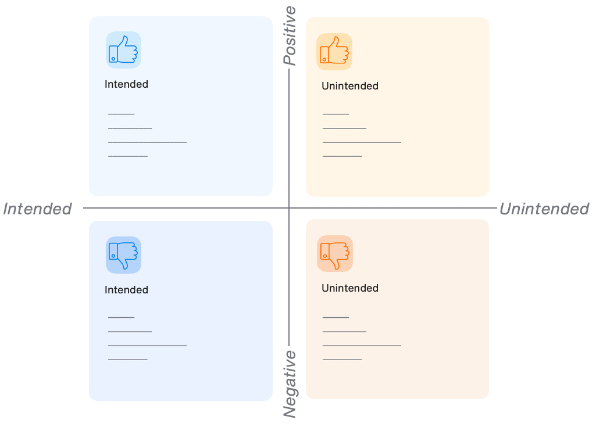
There are two phases in a Consequence Scanning Workshop. The first phase is the Ideation Phase, where participants will ask themselves three questions.
What are the intended and unintended consequences of this product or service feature?
Within these intended and unintended consequences, which are positive?
Within these intended and unintended consequences, which are ones we need to mitigate?
Next is the Action Phase where teams create an action plan to remedy, influence, or monitor each potential consequence.
As with any Ideation workshop, it’s important to get the teams to think creatively and holistically with compelling prompts and thought exercises. Here are some example prompts a facilitator might use:
“If this works exactly as planned, what new behaviors will it encourage?”
“Who might be disadvantaged by this?”
“How might someone misuse or repurpose this feature?”
“What could happen if this scales far beyond our expectations? Is there an impact on our planet? To our communities?”
“What could go wrong for people who are not in the room?”
“If the press wrote a critical headline about this feature in a year, what might it say?”
Many teams use a four-quadrant matrix to categorize and track these consequences. Through this close examination and categorization, teams hold themselves accountable for the impacts their products and services may create.
Reading Careless People was exhausting because it described decision after decision where leaders prioritized growth, engagement, and revenue without seriously examining their societal impact. What made the book so unsettling is that none of the technology itself was inherently evil. The systems worked exactly as designed. The failure was simple: nobody systematically asked what the consequences might be.
So if you don’t read the book, do this instead: Be a leader who refuses to be careless.
Build consequence scanning into how your teams work. Ask the uncomfortable questions early. Examine how your products might shape the world, not just your quarterly metrics.
Because once a system reaches millions of people, its consequences scale just as fast as its success.